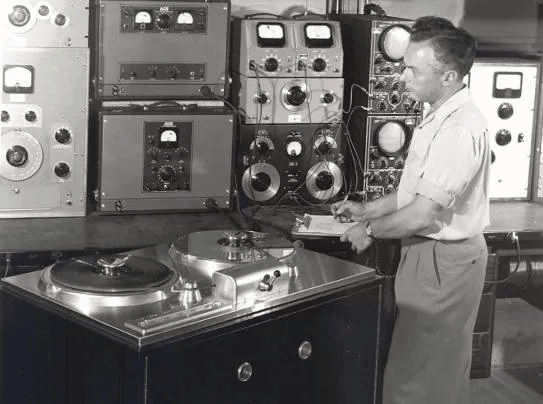
May 16, 2026, marks the 80th anniversary of the world’s first demonstration of a high-fidelity magnetic tape recorder to the Institute of Radio Engineers in San Francisco.
Today’s quiz is about the high-fidelity magnetic tape recorder (it’s a fascinating story)
In 1946, Engineer Jack Mullin demonstrates the world’s first high-fidelity magnetic tape recorder to the Institute of Radio Engineers in San Francisco.
Question A:
How did Jack Mullin discover the magnetic tape recorder?
Question B:
Who was the first well known celebrity to leverage the magnetic tape recorder?
Answer: Part A
During World War II, a young U.S. Army Signal Corps officer named Jack Mullin was stationed in England. Part of his job involved monitoring German radio broadcasts late at night.
Mullin noticed something bizarre: at 2:00 AM, German radio stations were broadcasting full, flawless symphony concerts. At the time, American and British radio programs were either completely live or played off large, scratchy phonograph records that lacked high fidelity and maxed out at a few minutes of playtime. Mullin realized the Germans must have had a secret recording technology.
The Discovery at the Castle
In 1945, when the Allies pushed into Germany, Mullin was sent to evaluate captured electronic equipment. He found a highly advanced audio recorder being used at a German Armed Forces Radio station in a castle in Bad Nauheim, north of Frankfurt. The device was known as the AEG Magnetophon.
Smuggling the War Souvenirs
Because the Magnetophon wasn’t classified as top-secret military hardware by the U.S. military, Mullin was given permission to keep two broken-down Magnetophon decks and 50 reels of German-made magnetic tape from BASF, as “war souvenirs.”
Army regulations stated that any souvenir sent home had to fit inside a standard mailbag. Mullin literally took the two heavy machines completely apart, packed the pieces into multiple mailbags, and shipped them back home to San Francisco.
The May 16, 1946 Demonstration
Back in California as a civilian in early 1946, Mullin spent months reassembling and modifying the German machines, building his own custom electronics to further optimize the sound quality.
On May 16, 1946, Mullin demonstrated his modified Magnetophon to the Institute of Radio Engineers at the NBC Studios in San Francisco.
He had behind a curtain, a microphone feed of a live orchestra and his modified Magnetophon. He switched between the live feed and the Magnetophon. When the curtain was pulled back, the audience of engineers and audio professionals was completely blown away.
Answer: Part B
Among those who caught wind of Mullin’s technology was the production team for Bing Crosby, who was then the biggest entertainment star in America.
Crosby hated doing his weekly radio show live because it required doing it twice (once for the East Coast, once for the West Coast) and prevented him from fixing mistakes. He tried pre-recording on phonograph records, but the audio quality was very poor.
When Crosby saw Mullin demonstrate the ability to not only record pristine audio but also physically cut and splice the tape with a razor blade to edit out bad jokes or mistakes without losing quality, he hired Mullin on the spot as his chief engineer.
Crosby invested $50,000 into a tiny, six-employee California company called Ampex. Using Mullin’s designs, Ampex created the Ampex Model 200, the first commercially successful American reel-to-reel tape recorder.
-The Winners-
Part A:
none
Part B
K8EA
Thanks for participating in the May 16th Net!
Ron / K4RJT
Great quiz!
Yep, good quiz! Where was the Admiral???